
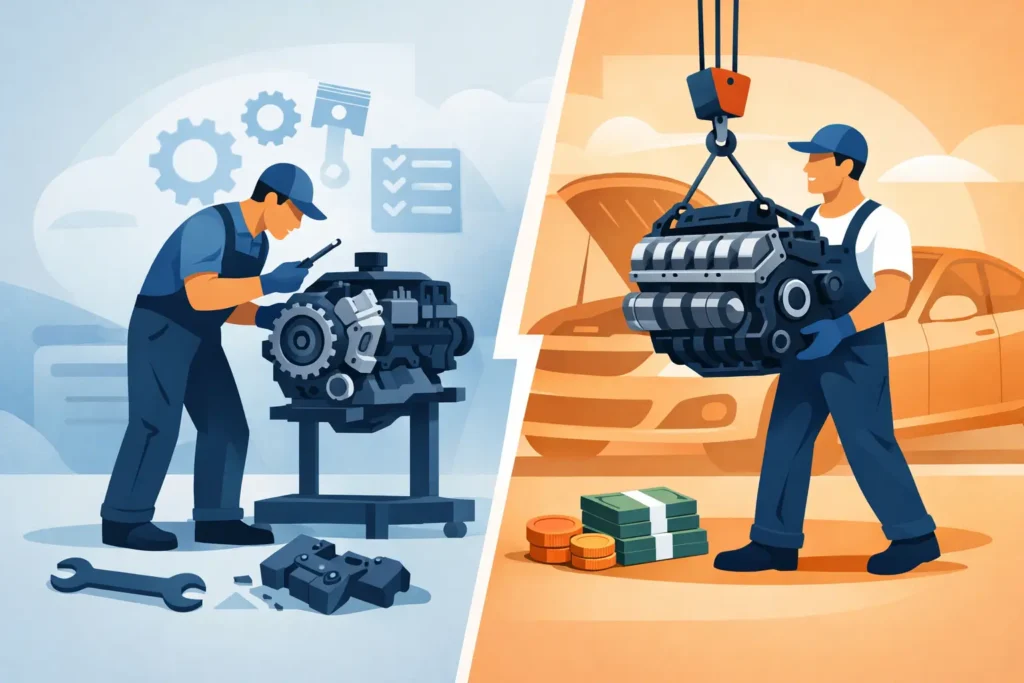
That knocking sound usually shows up before the real bad news does. Maybe the oil light flickered and went away. Maybe the truck started burning oil, running hot, or losing power under load. When you get to the point of deciding on engine repair or replacement, the wrong call can cost you twice – once in the shop, and again when the same problem comes back.
This is not a small decision, and it should not be treated like one. Some engines are worth repairing. Some are better candidates for a rebuild. Others are too far gone, and replacing them is the smarter move financially and mechanically. The key is knowing what failed, how deep the damage goes, and what you need from the vehicle after the job is done.
How to judge engine repair or replacement
The first thing that matters is the type of failure. A leaking gasket, bad timing components, failed water pump, damaged sensors, or top-end valvetrain problems may point to a repairable engine. Those jobs can be significant, but they do not always mean the whole engine is done.
A different story starts when the lower end is involved. Spun bearings, a thrown rod, cracked blocks, severe overheating damage, low compression across multiple cylinders, heavy sludge buildup, or metal throughout the oil system usually push the conversation toward replacement or a full rebuild. At that point, you are not fixing one part. You are dealing with an engine that has likely damaged itself internally in several places.
Mileage also matters, but not in a simple way. A high-mileage engine is not automatically junk, and a lower-mileage engine is not automatically worth saving. What matters more is maintenance history, how the vehicle was used, and whether the damage is isolated or widespread. A work truck that has been serviced on schedule may be a better repair candidate at 220,000 miles than a neglected commuter car at 110,000.
When engine repair makes sense
Repair is often the right move when the failure is limited and the rest of the engine is healthy. If compression is strong, oil pressure is within range, and there is no serious bottom-end noise, targeted repairs can restore performance without the cost of replacing the whole assembly.
This is common with issues like head gasket failure caught early, timing chain service before catastrophic damage, oil leaks that have not caused bearing wear, or cooling system failures that have not warped heads or cracked castings. In these cases, a proper diagnosis matters more than guesswork. Throwing parts at a problem is expensive. Testing compression, leak-down, oil pressure, and cooling system integrity gives you a real starting point.
Repair also makes sense when the vehicle has good overall value and the owner plans to keep it for years. If the transmission is solid, the suspension is decent, and the body is in good shape, investing in a focused engine repair can stretch the life of the vehicle at a lower upfront cost.
The trade-off is that repair only fixes what is known and visible at the time. If the engine has wear in multiple areas, one successful repair can uncover the next weak point. That does not mean repair is wrong. It means the inspection has to be honest.
When replacement is the smarter move
Replacement starts making more sense when the engine has major internal damage or when labor and parts for repair get too close to the cost of a replacement unit. This happens more often than people think.
For example, if an engine overheated badly enough to warp heads, damage bearings, and contaminate oil passages, the repair list gets long fast. Machine work, teardown labor, hard parts, gaskets, seals, and reassembly can add up to more than installing a quality rebuilt or remanufactured engine. The same goes for rod knock, multiple cylinder failure, cracked blocks, or complete lubrication failure.
Replacement is also the better option when downtime matters. If you rely on your truck for work, your van for deliveries, or your fleet vehicle for business, you need a solution that gets you back on the road with confidence. In many cases, sourcing the right replacement engine and installing it correctly is faster and more predictable than tearing down a badly damaged engine and waiting to see what else is ruined inside.
For buyers outside the local area, replacement can be even more practical. A tested replacement engine shipped nationwide gives independent mechanics and repair-minded owners a direct path forward without chasing questionable used inventory.
Repair, rebuild, or replace – know the difference
These terms get mixed together, but they are not the same.
Engine repair means fixing specific failed components while keeping the existing engine largely intact. That could include timing work, gasket replacement, valve work, cooling-related repairs, or addressing oil leaks and drivability issues.
An engine rebuild means the original engine is disassembled, inspected, machined as needed, and reassembled with new or reconditioned components. This is often the best option when the block and major castings are still usable, but the internal wear is too extensive for a simple repair.
Engine replacement means removing the damaged engine and installing another unit – often rebuilt, remanufactured, or a verified used engine depending on the application and budget. Replacement can save time, but the quality of the engine being installed matters just as much as the installation itself.
That is why in-house machine work and real engine specialization make a difference. A shop that handles diagnosis, machining, rebuilding, and installation under one roof has more control over quality than a general repair shop sending critical steps somewhere else. At FL Engines 4 Less, that hands-on process is a big part of how customers avoid paying for the same problem twice.
What cost really means in engine repair or replacement
Most people start with the upfront number, which is understandable. But the cheapest quote is not always the lowest cost.
A low repair estimate can look good until hidden damage appears after teardown. A bargain replacement engine can turn expensive if it has poor compression, unknown history, or compatibility issues. The real question is what you are getting for the money: tested parts, proper machining, qualified installation, warranty support, and a clear explanation of what is being done.
You also need to weigh the value of downtime. Missing jobs, rentals, towing, repeat breakdowns, and lost workdays all count. For commercial drivers and fleet operators, speed and reliability often matter as much as the labor line on the invoice.
If the vehicle is otherwise solid, paying more for the right engine solution can still be the better financial move than replacing the entire vehicle. On the other hand, if the transmission is failing, the frame has rust, or the vehicle has a stack of unrelated problems, putting major money into the engine may not pencil out.
Questions a good shop should answer before you decide
Before approving anything, you should know what failed, how the shop confirmed it, and whether the damage is isolated or system-wide. You should also know whether the estimate includes teardown findings, what parts are new or reconditioned, whether machine work is required, and how long the vehicle is expected to be down.
If you are considering replacement, ask where the engine came from, whether it has been inspected or tested, what components are transferred from your original engine, and what warranty applies. A straight answer matters. So does a shop willing to explain why one path makes more sense than the other.
You do not need sales pressure. You need a diagnosis that matches the condition of the engine and the value of the vehicle.
The best choice depends on what you need next
If you need the lowest immediate spend and the damage is limited, repair can be the right move. If you want to keep the vehicle long-term and the original engine is rebuildable, a rebuild may give you the best balance of value and control. If the engine is badly damaged or downtime is killing you, replacement is often the cleaner path.
There is no one-size-fits-all answer to engine failure. The right call comes from looking at the damage, the budget, the vehicle, and how hard you need it to work when it goes back on the road. Get the full picture first, then make the decision once – and make it count.