
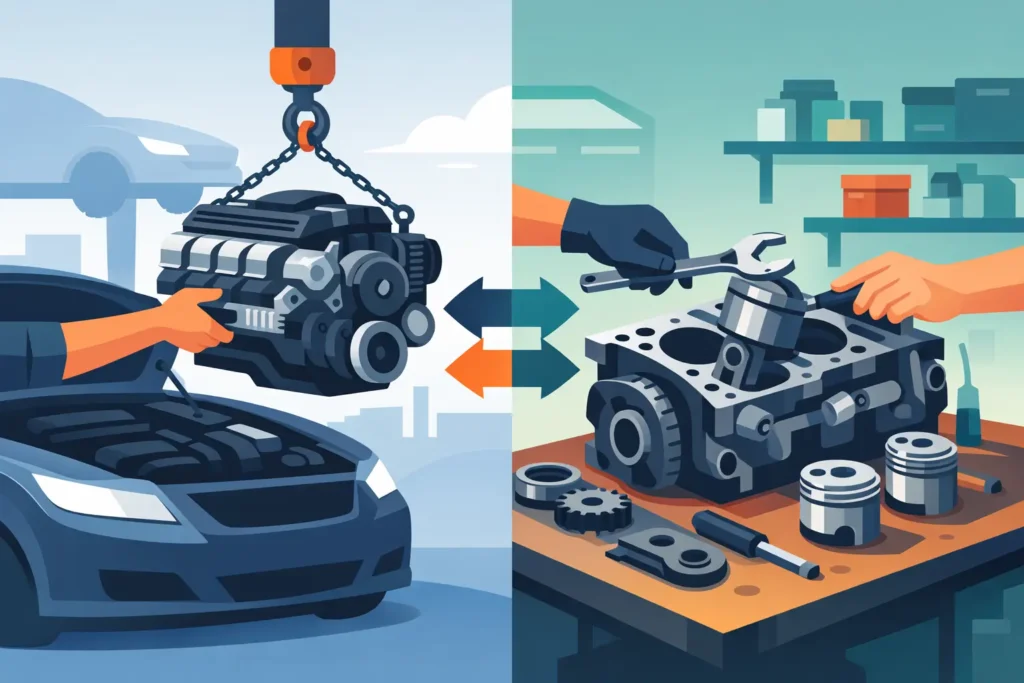
When an engine starts knocking, burning oil, or loses compression across multiple cylinders, the question gets real fast: engine swap vs rebuild. This is not a small maintenance decision. It affects your budget, your downtime, and how confident you feel turning the key a month from now.
A lot of drivers come in thinking one option is always cheaper or always better. It is not that simple. The right move depends on what failed, what vehicle you have, how long you plan to keep it, and whether the rest of the engine is worth saving.
Engine swap vs rebuild: the basic difference
An engine rebuild means your original engine is taken apart, inspected, machined where needed, and reassembled with new or reconditioned components. That usually includes parts like bearings, rings, gaskets, seals, and often pistons, timing components, oil pump parts, and valvetrain pieces depending on wear and damage. The goal is to restore your engine properly, not just patch it.
An engine swap means removing the damaged engine and replacing it with another engine. That replacement could be used, rebuilt, or remanufactured. In most everyday repair situations, people use the phrase engine swap to mean replacing the original engine with a ready-to-install unit rather than rebuilding the one already in the vehicle.
Both can solve a major engine problem. The difference is in time, parts condition, machine work, labor strategy, and long-term value.
When a rebuild makes more sense
A rebuild is often the smarter route when your original engine is still a good core. If the block is usable, the heads are salvageable, and the major hard parts are not catastrophically damaged, rebuilding lets you keep the engine that belongs in the vehicle while correcting the wear that caused the failure.
This matters more than some owners realize. If you know the history of your engine, that has value. You know whether it was maintained, whether it overheated, whether it sat for years, and what symptoms showed up before failure. With an unknown used engine, you are taking on more guesswork.
A rebuild also makes sense when machine shop quality is available in-house and the work is being done by people who handle engines every day, not a general repair shop that only sends everything out. Precision matters here. Cylinder measurements, crankshaft condition, head surfacing, valve work, and clearances are what separate a real rebuild from an expensive temporary fix.
For trucks, work vehicles, and diesel applications, rebuilding can be especially attractive because the platform may be worth keeping on the road. If the body, transmission, and chassis are solid, investing in the original engine can be a practical long-term move.
When an engine swap is the better call
Sometimes the original engine is too far gone. A thrown rod, cracked block, severe overheating damage, or major internal destruction can turn a rebuild into a money pit. At that point, replacing the engine may be faster and more cost-effective.
An engine swap is also a strong option when downtime matters. If you rely on your truck for work or your car for daily commuting, waiting on teardown, machine work, parts sourcing, and reassembly may not be ideal. A quality replacement engine that is in stock can shorten the repair timeline significantly.
This is where inventory matters. If the correct replacement engine is available and properly matched to your vehicle, a swap can get you back on the road with less delay. For some owners, that difference alone decides the job.
There is also a budget reality. While rebuilds can be the best value in the right case, they can become more expensive if hidden damage shows up after disassembly. An engine that looks rebuildable from the outside may need more machining and more hard parts than expected. A replacement engine can sometimes provide a clearer path on cost from the start.
Cost depends on what failed
Anybody who tells you one option always costs less is skipping the hard part of diagnosis.
A rebuild can be less expensive if the block, crank, rods, heads, and other major components are reusable with normal machine work. But if the engine has severe damage, the parts and labor can stack up quickly. Once you add head damage, valvetrain failure, damaged cylinder walls, rotating assembly issues, and oil contamination cleanup, the number changes.
An engine swap can be cost-effective if a solid replacement is available at the right price. But the cheapest replacement engine is not always the cheapest repair in the long run. A bargain used engine with unknown wear can lead to another failure, more labor, and more downtime.
The real comparison is not rebuild versus swap in the abstract. It is rebuilding your specific engine versus installing the specific replacement available for your vehicle.
Reliability is about quality, not just the option
Some customers assume a swap is more reliable because it is quicker. Others assume a rebuild is more reliable because everything gets refreshed. Both ideas can be true, and both can be wrong.
A properly rebuilt engine can be extremely reliable because worn components are addressed, machine work is done to spec, and the assembly is controlled from start to finish. You are not gambling on unknown history. You are rebuilding from measured condition.
A replacement engine can also be a reliable solution if it comes from a trusted source and has been inspected or rebuilt correctly. The problem is that not all replacement engines are equal. There is a big difference between a tested, quality unit and an engine pulled from a wreck with little documentation.
That is why the shop doing the work matters as much as the option you choose. The best plan is only as good as the diagnosis, machining, parts quality, and installation behind it.
Vehicle type changes the answer
For a newer vehicle with good overall value, either option can make sense, depending on the damage. For an older vehicle with high miles but a strong body and transmission, a rebuild may keep a known platform alive without taking a chance on an unknown used engine.
For fleet vehicles and work trucks, the decision often comes down to downtime and return on investment. If the truck earns money, time out of service hurts. A ready replacement engine may be the best business decision even if the rebuild is technically possible.
For diesel owners, the answer gets even more case-specific. Diesel engines are expensive, heavy-duty, and often worth repairing if the platform is still in good shape. But diesel failures can also involve injectors, turbo issues, cooling system problems, and fuel contamination, so the engine decision should never be made in isolation.
What a good shop looks at first
Before anyone should recommend a rebuild or a swap, the engine needs to be evaluated correctly. Compression loss, oil pressure, metal in the oil, overheating history, block integrity, head condition, and the root cause of failure all matter.
If the root cause is not addressed, neither option solves the real problem. A new or rebuilt engine installed into a vehicle with a cooling system problem, oiling issue, bad fuel delivery, or control problem is headed for trouble. Good engine work starts with accurate diagnosis, not guesswork.
That is one reason specialized engine shops usually give better answers than shops that mainly do general service. Engine failure is not just about replacing parts. It is about understanding why the failure happened and whether the engine you have is worth saving.
So which one should you choose?
If your original engine has rebuildable hard parts, you want to keep the vehicle, and you have access to real machine shop capability, a rebuild can be the strongest long-term value. It keeps the known engine in place and restores it the right way.
If the engine has major structural damage, replacement is available, or you need the vehicle back quickly, an engine swap may be the better path. It can reduce downtime and avoid sinking money into a block or head that should not be reused.
At FL Engines 4 Less, this is the kind of decision that needs a straight answer, not a sales pitch. Some engines are worth rebuilding. Some are better replaced. The right call comes from inspection, measurements, parts availability, and what makes sense for your vehicle and your budget.
If you are stuck between the two, do not start with the question of what is cheaper. Start with what failed, what is still usable, and how long you need the repair to last. That is usually where the right answer shows up.